Total Pageviews

Showing posts with label fuel level. Show all posts

Friday, September 18, 2015

Bad Aircraft Fuel Level Indication Can Lead to Aircraft Fuel Starvation.

Really Where's your Proof 

Yes I know you have read every publication put out by AOPA and the FAA and they clearly say fuel level indication is clearly a pilot error issue.  In NTSB reports they have a rubber stamp that reads like the following :

"The pilots improper pre-flight and inflight planning, which resulted in fuel exhaustion."
What most in the general aviation community opinion on this issue is referred to as Fundamental Attribution Error.  (FAE) This is where we naturally blame people, even when circumstances or conditions are the primary issue.  

Last week I wrote a blog with the intentionally provocative title: "Let's Legislate Accurate AIrcraft Fuel Level"

For this I received the expected typical responses below: 
"How about we simply look at the number of people that have fuel related accidents and see if they did a proper preflight ...which...since you keep going by FAR's is required. If they didn't do a preflight correctly...they are poor pilots...and if they are poor pilots...gauges won't make a difference. You can't save people from being stupid"
"So, how much of this is lack of awareness, poor training or just laziness I do not know. But this is one of the most preventable accidents out there that keeps happening on a regular basis. I am not convinced an AOPA video will change that.  That is the real crime. They are still happening twice a week and none of them have to."

You would actually expect this pilot response to the provocative inquiry.   In looking at this as a pilot cultural issue or a FAE  the concept of  "Just World Phenomenon" features prominently.  This is the belief that people get what they deserve and deserve what they get.   


Unfortunately, the just-world hypothesis also results in a tendency for people to blame and disparage victims of an accident or a tragedy.  It is actually a protective strategy of the mind, providing mental separation from those kind of pilots that run out of fuel.   It won't happen to me, I am not like one of those pilots.

Sorry - These are random events and they happen to good pilots - I have a files and files from Transportation Boards across the world - you are not immune.  You have a doppleganger who was just as careful as you are and ran out of fuel in their aircraft.   I am sorry to burst the protective bubble.

What appears to happen in General Aviation is that, blame for fuel starvation, falls squarely on the those pilot shoulders .  This appears to be cultural phenomenon among pilots of all types.  The primary message we hear is that education will cure the miscreants, those bad pilots that will always get into trouble.


Very rarely do we delve into the situational factors of the fuel starvation issue at hand.  Our cultural bias doesn't allow that possibility.


-------------------------------------------------------------------------------------------------------------
-------------------------------------------------------------------------------------------------------------


Fuel indication in aviation is loathsome at best - it is not a deep dark secret that most aircraft fuel indication systems are marginal from the start. 

 When you compound a marginal system with poor or no maintenance,  you can make a general statement that a functionally inoperative fuel gauge is common place in aviation.  

This is illustrated by responses from a General Aviation News inquiry as to what pilots felt about general aviation fuel level indication.
"Maybe they’re also more in the habit of keeping an eye on the clock in flight, even sneaking the occasional glance at those notoriously inaccurate fuel gauges." 
"Airplanes are legendary for having inaccurate fuel quantity gauges" 
"These devices are notoriously inaccurate, showing empty when there are gallons left in the tank and showing full for the first 1/2 hour."
"Aircraft fuel gauges can be notoriously inaccurate." 
"Without a means of measuring fuel flow, you must rely on the aircraft fuel gauges or total time of flight. Aircraft fuel gauges are notoriously inaccurate (they are only required by the FAA to read accurately when displaying empty)." 
"Aircraft fuel gauges have a well-deserved reputation for being unreliable and the FARs only require that fuel gauges read correctly when they are empty!" 
"Second, as others have said aircraft fuel gauges have historically been
poorly designed and grossly inaccurate.  Many will indicate something significantly different in a climb vs a descent and there are some airplanes with fuel gauges that are designed to read full until a substantial amount of fuel has been consumed." 
"Don’t bet your life on your fuel gauges, visually check the fuel level by “dipping” all tanks. Some aircraft models have notoriously unreliable fuel gauges." 
"All light aircraft gauges are notoriously, infamously and reliably, unreliable." 
"Sounds great in theory, but I have not yet seen an accurate Cessna fuel gauge, Ever. A fairly expensive AD would be the only thing that would ever change that."
I don't think a statement that  "Aviation fuel level indication could be improved" would fall very far from the mark. 

------------------------------------------------------------------------------------------------------------

Better fuel indication will lead to better decisions and appropriate warnings in aviation.  


While it seems obvious to a layperson

Strangely, Thats not the popular opinion in GA.  But here is the proof. 


EASA (European FAA) - In a Transport Aircraft study for revisions to required powerplant instruments.  EASA showed that better fuel indication would have improved the result of the 65 incidents and accidents in Transport AIrcraft - well over 70% of these accidents/incidents could have been avoided.  Transport aircraft are not GA, but it is the same mode.

CASA (Australian Civil Aviation Authority) Requires that aircraft fuel Indication in Australian aircraft meet a performance standard, every 4 years.   The reasons cited are improving the fuel starvation incident and accident rate. 

TSBC (Transportation Safety Board of Canada) Makes findings of faulty fuel indication a factor in fuel starvation events.  They point to the wide use of fuel sticks as an indication that fuel level reliability could be improved in aviation
 The fuel quantity indicators on this type of aircraft were not reliable. As a result, the pilot could not be sure of the quantity of available fuel in the left tank during flight.

Tests on the components of the fuel level indication system established that the only time the fuel level in the wing tank was shown correctly was when the tank was empty 

The Bell 214B and Bell 205 flight manuals be modified to provide information regarding the inaccuracy of fuel quantity indications, thereby allowing pilots to make informed decisions in the event of a loss of fuel boost pump pressure. 
------------------------------------------------------------------------------------------------------------

Cognitive Bias 

While these two points are associated with the same system and appear plain as day 

  1. General Aviation Aircraft have inaccurate fuel level indication.
  2. General Aviation Aircraft are prone to fuel starvation and fuel exhaustion.

A general aviation pilot won't recognize those statements as connected. 

Why: 

Anchoring Bias -  The tendency to rely too heavily, or "anchor", on one trait or piece of information when making decisions (usually the first piece of information that we acquire on that subject.

Pilot's are told to never trust the fuel gauge on the first training flight. 

Availability Cascade A self-reinforcing process in which a collective belief gains more and more plausibility through its increasing repetition in public discourse (or "repeat something long enough and it will become true.

Bandwagon Effect The tendency to do (or believe) things because many other people do (or believe) the same.

AOPA, FAA continually tell us that we need to use proper pre-flight procedure including sticks.
Confirmation Bias The tendency to search for, interpret, focus on and remember information in a way that confirms one's preconceptions
Aircraft fuel gauges only have to be accurate at zero 
You're only interested in selling senders  
-------------------------------------------------------------------------------------------------------------------------
I have a passion for European Sports cars of the 50's and 60's  and I was talking with a group of MG-TC owners.  The subject of fuel indication came up and the MG owner brought out his calibrated stick.   MG T Series cars don't have a fuel gauge, they have a warning light, and Old British cars being what they are the warning light isn't a trusted component or indication of anything of merit.    

I mentioned that small aircraft use a stick as well to determine fuel quantity.  There were lots of raised eyebrows and a few quizzical looks.    The very first statement I heard was.

  "I bet they run out of gas"
  followed by 


"They can't just pull over and check with the stick can they"

I told them the various reasons why,  and they asked if something was being done to improve that.  

I told them sadly no.  A pilot will go out today after purchasing a new aircraft and obtain a stick to measure their fuel.  

It's  startling commentary, that in aviation, we use fuel measurement methods and techniques to prevent running out of fuel that were common on minimal equipment British sports cars of the 40's & 50's.  

I hope it makes us think.



Tuesday, August 11, 2015

Beech Baron CiES Magnetic Fuel Level Sender Retrofit - Part 1

Beech Baron 55 Fuel Level Senders

We received a set of Beech Baron fuel level senders yesterday.  In the coming days we will quantify the major characteristics of these senders like the arm length and position so that we can make new CiES Digital Magnetic Field Senders to accurately read the volume in the Beech Baron fuel tanks - Both the Main and Aux.  

Stay tuned for further updates and pictures.

Friday, July 3, 2015

Turboprop Fuel Level Indication

TURBOPROP FUEL QUANTITY INDICATION

We are consistently being tapped by new product development teams in aviation for Turboprop fuel level indication. 

Aircraft and Rotorcraft Manufacturers are finding that CiES provides high quality fuel quantity indication systems.  
Fuel Quantity Suite - Temperature Compensation - Automatic Switching  

Our system is so accurate that we provide fuel quantity switching for single engine aircraft that utilizes fuel tank quantity as the only sensor system utilized to balance fuel tanks.   That's right - no more switching tanks on the 1/2 hour, it is now accomplished automatically on many of the platforms we are now serving.


DIGITAL FUEL LEVEL


Our digital fuel level technology utilizes modern sensors to detect fuel level or ullage boundary and output the either the native digital information or convert the digital signal to an analog output for use in legacy aircraft platforms.  Our consistent high quality performance indicates that our signal is not degraded with fuel type, fuel contamination, fuel temperature or entrained air.

In fact we accomplish this without any electronics in the fuel volume.


SIMPLE SYSTEM - HIGH QUALITY 

The high technology sensor combined with a simple mechanical system is patented by CiES for measuring fuel level.   Our demonstrated quality output, illustrates our effectiveness in fuel measurement. 

UNCOMMON VALUE

The fact that our fuel indication system is finding its way onto so many new Jet A platforms shows that CiES offers an uncommon value in aviation.

The CiES fuel quantity solution represents both a higher quality and a more cost effective solution than  traditional Jet A fuel quantity systems  --- We are worth looking into. 


Monday, April 27, 2015

Cardinal Flyers Organization Digest - Sun & Fun

FROM THE Cardinal Flyers Organization DIGEST 

JP Instruments, the engine monitor folks, shared that they continue to work with CIES, a friend of CFO's, who have introduced a superior design fuel level transmitter.

JPI EDM 930


The JPI930 certified engine instrument replacement already works with the CIES transmitter in native mode, frequency domain.


JPI EDM 900


The JPI900 certified engine instrument replacement works with the CIES transmitter in voltage or current mode.


CiES Inc 177 Fuel Senders 
Several Cardinal owners have already ordered the CIES transmitters to improve repeatability and accuracy of their fuel level measurements, while reducing installation cost and fuss, and hopefully achieving longer term reliability.

www.jpinstruments.com

www.ciescorp.net

Monday, June 23, 2014

USA Today "Unfit for Flight"


There has been a lot of discussion in the aviation community about this 3 Part Expose' Series in      USA Today - Most of our aviation community agree that - we should strive to make aviation safer.  Most of us on this side of the fence,  also agree that the condemnation of manufacturers in this industry was - just a little slanted.  I happen to know several of the players and the other side to many of the examples and lawsuits presented.   It is not as cut and dried as the articles suggest.

Mr Bertorelli - who I respect as an aviation journalist and pilot - made several good points in his Blog  As most people are aware - Aviation is the "most regulated business in the world".  In this industry we laugh at drug and medical device companies - because they have it easy.    In this environment how could an outside news agency find fault with our industry.    Given the economics of this particular business,  it isn't profitable to do a bad job.   Paul stated all of this in his blog very clearly:
There’s wide agreement that over regulation has had a hand in getting us into this mess, so further regulation — of manufacturers or more stringent training requirements —won’t get us out of it.   The entire community just doesn’t have the stomach for it. And neither do I, frankly.  Not to mention the utter lack of any economic engine to drive it all.
I was however struck today with one of Mr. Bertorelli's responses to this safety issue - and because an element of the rebuttal involved a segment of the aviation industry that I have become quite familiar.

At this point, we work on fuel level systems in aviation and most recently the automotive industry.

We have a unique but very narrow viewpoint.

GA Safety: All Heat, No Light

Excerpt from Paul Bertorelli's Blog 

As a refreshing change, the USA Today report almost tried to cast pilots as steely eyed but hapless victims of shoddy manufacturing and outdated aircraft designs. Were it only so. None of us have to look in the mirror to know that although out-of-the-blue mechanicals do cause accidents, preventing every one of that category wouldn’t change the accident rate much.
Even in some of the egregiously poorly prepared reports, the pilot obviously did something stupid—like flying into bad weather, overloading the airplane or, a perennial favorite, running the tanks dry because the fuel gauges aren’t accurate.  

That last item is a cultural thing in which automotive knowledge contaminates aviation thinking. It’s like that GEICO commercial; everybody knows the gauges aren’t accurate and we have means to work around this deficiency.
 
Using a crash as a means of highlighting it seems somehow unsporting. Yeah, the stupid gauges should work, but no, they don’t.  So buy a totalizer or learn to use a watch.
But unless you, as the owner or pilot, take personal responsibility, your 35-year-old Cessna 172 is not going to be fitted with more accurate fuel gauges. 

-------------------------------------------------------

Unfortunately neither the NTSB or FAA equate "Bad Fuel Gauges" to Fuel Exhaustion,  but it is interesting that Paul does state this in his blog.  It is quite common to report to the NTSB or FAA after an accident that the fuel gauges are not accurate in your damaged aircraft.  There is no consequence to those statements.  If your flight plan did not indicate average fuel burn - look out.  

I also agree that fuel level is a cultural thing in aviation - I am not familiar with the GIECO reference Paul equates - but fuel level in automotive applications is barely adequate, the website tankonempty.com illustrates this very well.  The issue in aviation, is that for most small aircraft, the fuel level system was taken from a ground vehicle system, think automotive, tractor, truck - This system, was barely adequate for an automotive application as illustrated by the website above  - and this system really struggles with fuel quantities that are 3 times larger, and the fuel and vehicle movement that occurs in aviation.

When we talk to people outside aviation - and we state things like Paul's statement "Yeah the stupid gauges should work, but no, they don't"     - they look at first puzzled and then to a each non aviation person we have stated this quizzes us back "Don't small aircraft run out of fuel"  Yes they do. 
   The National Highway Transportation and Safety Administration - NHTSA in a recent automotive recall for bad automotive fuel fuel gauges on Chevrolet Trucks stated that the there was an obvious safety issue with having bad fuel gauges  - specifically from the recall announcement:
"If a customer runs out of fuel without any warning from the fuel gauge, it will cause the vehicle to stall and increase the risk of a crash, the company said."
In aviation, as Paul Bertorelli stated for fuel level  - "we have work arounds". 

-------------------------------------------

As I am focussed on a small aspect of the aviation safety issue - and this is seemingly the common aviation response to a significant issue. 

Because from where I am sitting -  maybe the pilot of the 35 year old Cessna 172 should at the least have the fuel gauges checked and calibrated at annual. 

If the gauges are too far gone - he should have the maintenance facility send in a Service Difficulty Report to the FAA - let the Feds know we have an issue out here in the field.   Let's quit making excuses or work arounds for equipment that should and by law be required to function correctly. 

I think we as a community should start questioning these common assertions and take off the cultural blinders.  

-------------  

I think we all want to make aviation safer - including USA Today.


Friday, June 6, 2014

Aircraft Fuel Mismanagement Cause and Effect

Aircraft Fuel Mismanagement - Cause and Effect

This is what we know about aircraft fuel instrumentation 

  • "Maybe they’re also more in the habit of keeping an eye on the clock in flight, even sneaking the occasional glance at those notoriously inaccurate fuel gauges."  
  • "Airplanes are legendary for having inaccurate fuel quantity gauges"
  • "These devices are notoriously inaccurate, showing empty when there are gallons left in the tank and showing full for the first 1/2 hour."
  • "Aircraft fuel gauges can be notoriously inaccurate."
  • "Without a means of measuring fuel flow, you must rely on the aircraft fuel gauges or total time of flight. Aircraft fuel gauges are notoriously inaccurate (they are only required by the FAA to read accurately when displaying empty)." 
  • "Aircraft fuel gauges have a well-deserved reputation for being unreliable and the FARs only require that fuel gauges read correctly when they are empty!"
  • "Second, as others have said aircraft fuel gauges have historically been poorly designed and grossly inaccurate. Many will indicate something significantly different in a climb vs a descent and there are some airplanes with fuel gauges that are designed to read full until a substantial amount of fuel has been consumed."
  • "Don’t bet your life on your fuel gauges, visually check the fuel level by “dipping” all tanks. Some aircraft models have notoriously unreliable fuel gauges."
  • "All light aircraft gauges are notoriously, infamously and reliably, unreliable."
  • "FAA safety guidance information states that fuel gauges are subject to malfunctions and errors, and certification regulations only require that a fuel gauge read “zero” during level flight when the quantity of fuel remaining in the tank is equal to the unusable fuel supply. Therefore, fuel gauges should not be depended upon for checking the fuel quantity in a tank"
  • "Sounds great in theory, but I have not yet seen an accurate Cessna fuel gauge, Ever. A fairly expensive AD would be the only thing that would ever change that."
  • "Unfortunately, fuel quantity gauges in aircraft are often inaccurate at quantities above zero. While this does not mean that they can be ignored, it does justify the use of another tool to provide a more accurate total picture of the fuel quantity."
    ... and on and on and on and on and on.

    This is who takes the blame.

    • "The pilot's inadequate preflight preparation, which resulted in fuel exhaustion, and subsequent loss of engine power during cruise flight."
    • "The pilot's inadequate in-flight planning/decision which resulted in fuel exhaustion. A contributing factor in the accident was the pilot's inadequate preflight planning/preparation to ensure an adequate fuel supply was available for the intended flight."
    • "The pilot's inadequate preflight planning which led to fuel exhaustion and subsequent loss of engine power."
    • "A loss of engine power due to fuel exhaustion during approach, inadequate preflight planning/preparation by the certified flight instructor (CFI)."
    • "The pilot's inadequate preflight inspection, which failed to determine the fuel supply in each fuel tank, and his mismanagement of the fuel supply, which resulted in fuel starvation."
    • "A loss of engine power due to the pilot's inadequate preflight planning which resulted in fuel exhaustion."
    • "The pilot's inadequate preflight planning and his failure to verify fuel consumption during flight that resulted in fuel exhaustion and subsequent collision with obstacles and the ground."
    • "The pilot's departure with insufficient fuel for the planned flight, and his improper in-flight fuel management, which resulted in a total loss of power in both engines due to fuel starvation."
    • "The pilot's inadequate preflight planning and failure to verify the amount of fuel onboard the airplane prior to departure, which resulted in loss of engine power due to fuel exhaustion."
    • "The pilot's inadequate preflight preparation and failure to verify the fuel supply, which resulted in fuel exhaustion and subsequent loss of engine power."
    • "The pilots improper preflight planning and preparation which resulted in a loss of engine power due to fuel exhaustion."
    • "The pilot's failure to refuel, resulting in fuel exhaustion and a subsequent loss of engine power."
    • "The pilot's inadequate preflight and mismanagement of the fuel supply, which resulted in fuel exhaustion."
    • "The pilot's inadequate preflight planning of fuel required for the flight that resulted in fuel exhaustion and the subsequent loss of engine power."
    • "A total loss of engine power due to fuel exhaustion as a result of the pilot's inadequate preflight fuel planning."
    • "A total loss of engine power during a go-around due to fuel exhaustion as a result of the pilot's inadequate preflight planning."
    • "The inadequate preflight inspection by both pilots, resulting in a loss of engine power due to fuel exhaustion."
    • "A total loss of engine power due to fuel exhaustion as a result of the pilot's inadequate preflight planning."
    • "Improper planning/decision by the pilot, which resulted in fuel exhaustion due to an inadequate supply of fuel."
    • "A loss of engine power during approach due to fuel exhaustion as a result of the pilot's fuel mismanagement."
    • "A total loss of engine power due to fuel exhaustion as a result of the pilot's inadequate preflight fuel planning."
    ... and on and on and on and on and on.

    I am suggesting the aviation community take a closer look at the causes and effects of Fuel Exhaustion and Fuel Starvation events. 


    Monday, May 12, 2014

    PA28 Lands on a Road

    A 1968 Piper PA-28R-180 Cherokee single-engine aircraft with four persons on board made an emergency landing on southbound Interstate I-15 between Escondido, Calif., and El Norte Parkway on Sunday evening, July 22, 2012 at 11:25 p.m. PDT according to reports published on Monday, July 23 by KGTV 10News San Diego, the Los Angeles Times, the Kathryn's Report, the North County Times, and other media.
    The pilot, 48-year-old Ken Gheysar of Orange, Calif., was en route from Mammoth Yosemite Airport (MMH) to McClellan-Palomar Airport (CLD) in Carlsbad, Calif., but ran out of fuel and decided to put down on the freeway.
    According to CHP officer Jim Bettencourt, "Since traffic was light at that hour he was able to land safely and make it to the right shoulder of the freeway just north of El Norte Road."
    The plane landed safely and was undamaged, until the tip of the left wing was clipped by 74-year-old Milton Loy of Poway, who was driving a 1995 Dodge Dakota, causing minor damage to the aircraft and pickup truck.
    Airport Examiner

    NO NTSB Action

    PA28 Lands on a Parkway

    Instructor-Pilot Lands Stalled Single Engine Plane Safely on Palm Coast Parkway

     | MARCH 13, 2013
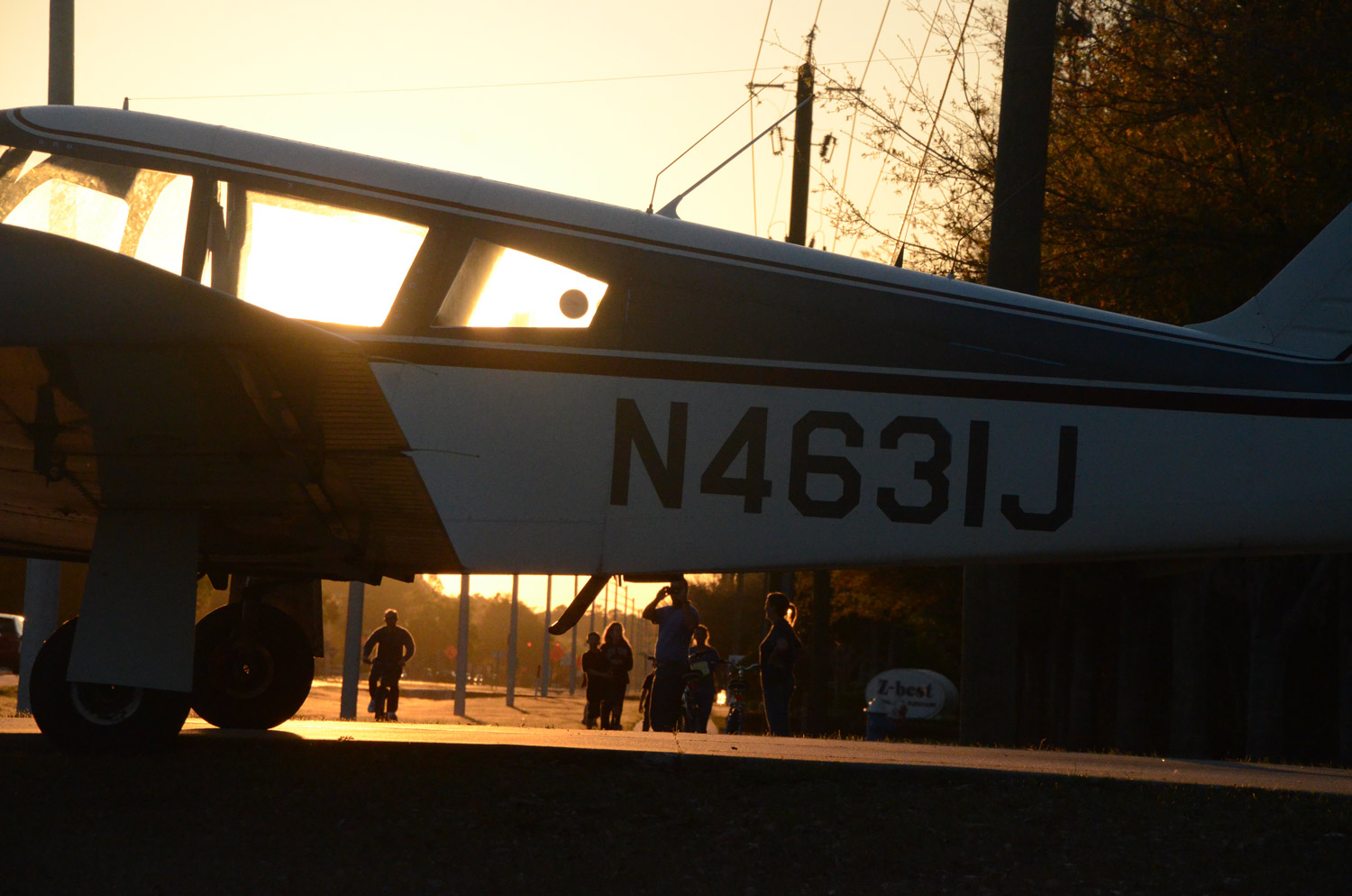
    The Piper after it had been pushed off Palm Coast Parkway, sitting in the setting sun as onlookers took in the scene. Click on the image for larger view. (© FlaglerLive)
    The Piper after it had been pushed off Palm Coast Parkway, sitting in the setting sun as onlookers took in the scene. Click on the image for larger view. (© FlaglerLive)
    Phoenix East flight school’s Raul d’Souza is a hero: the young instructor was piloting a plane late this afternoon, practicing emergency landings with a student, when the plane ran into engine troubles–and forced D’Souza, 34, to execute an emergency landing in the heart of Palm Coast. He did so nearly flawlessly.
    Raul d'Souza, a new Sully Sullenberger, immediately after the landing. Click on the image for larger view. (© FlaglerLive)
    Raul d’Souza, a new Sully Sullenberger, immediately after the landing. Click on the image for larger view. (© FlaglerLive)
    With him was Joo Lee, 33, who looked distinctly shaken from the experience. They both smoked, paced, sat, and smoked again soon after the landing. They’re both based at Phoenix East Aviation, on Pearl Harbor Drive in Daytona Beach. D’Souza, who’s been at the flight school since at least 2004, maintains a YouTube page of favorites that includes several video clips from the flight school.
    An SUV–or at least a large white car–had to do an evasive maneuver as the eastbound plane negotiated the two rather narrow lanes of Palm Coast Parkway west, and a huge semi, carrying cars, was also on the road; the plane faintly clipped the truck, but managed to land on the road. The truck had been parked on the shoulder, having just picked up a Mercedes from Parkway Self Storage. The plane clipped its left-front guide-pole with the marker light on its left wing, which shattered, leaving tiny and still-visible fragments on the fender above the truck’s left-front-tire. The plane also clipped the air cleaner, which was dented.

    The single-engine Piper, built in 1968, landed safely at 6:45 p.m. on Palm Coast Parkway, just west of Belle Terre. The plane sat on the road for less than 20 minutes before authorities and one of the two occupants of the plane pushed it off the road and parked it at the entrance of Parkway Self Storage. The wesbound lanes of Palm Coast Parkway were shut down only briefly.
    The plane belongs to Daytona Aircraft Leasing Inc., based at the same address as the flight school. D’Souza had reported engine trouble to the Daytona airport’s tower just after 6:30 p.m. Authorities in Flagler got the call of a plane in distress at 6:37 p.m., when dispatch announced an airplane emergency, describing a plane approaching Palm Coast Parkway from the west, toward the east, and possibly looking to land there. Shortly afterward, the landing took place.
    The pilot and his passenger declined to be interviewed, referring questions to their safety supervisor, who was on his way from Daytona Beach. The Florida Highway Patrol was investigating the incident, which it categorized as a crash the moment the plane struck the truck.
    Hayden Gordon, whose truck the plane clipped on its landing approach. The dented air cleaner is visible behind him. Click on the image for larger view. (© FlaglerLive)
    Hayden Gordon, whose truck the plane clipped on its landing approach. Click on the image for larger view. (© FlaglerLive)
    Hayden Gordon, 52, has owned the truck since 1999, and said he’d never had any road incident resembling his experience Wednesday afternoon. He’s based in Port St. Lucie. He was on his way to New York City, after starting to pick up cars in Miami. He had three on the truck. “I didn’t really see it,” Gordon said of the plane’s approach. “I was parked here, I’d just put the car up, and I was right here, getting ready to chain it” he said, describing his position to the right of the truck, with the truck blocking his view of the parkway. “Then I hear the sound, I hear it go boom. So when I spin around I saw the plane. There was a car coming. The car went right under. The car went right under it, yeah?” It was a white car. “And I saw the plane hit the ground and run out.”
    Gordon ran down to see the pilots, who had immediately bailed from the plane and run to the south shoulder of the road, on the grass. “It kind of scared me a bit, you know,” Gordon continued, after he’d realized what had unfolded, but “they were fine,” he said of the plane’s occupants. “The guy said his engine went out, he tried to start it but it wouldn’t start.”


    No NTSB Action 

    Fuel Exhaustion - Another PA28 Finds a Road

    Plane makes emergency landing on Watterson

    Posted: Oct 07, 2010 8:22 PM PDTUpdated: Oct 08, 2010 8:08 AM PDT
    By Marisela Burgos - bio | email
    Posted by Charles Gazaway - email 
    LOUISVILLE, KY (WAVE) - Early Friday morning, emergency crews remained on the scene of a small plane that made an emergency landing on the Watterson Expressway near Taylorsville Road.
    The plane, a Piper PA-28, landed in the westbound lanes of the Watterson just west of the Taylorsville Road ramp shortly after 11 p.m. Thursday. Four people were reported to be onboard, but no injuries were reported.
    The aircraft came to a stop on the grassy shoulder of the interstate off the driving lane. Traffic on westbound Watterson was flowing using the outside lanes.
    According the FAA website, the registered owner of the plane is Benjamin Price of Fisherville, KY. It is not known if Price was onboard the aircraft at the time of the emergency landing.
    Kathleen Bergan, communications manager of the FAA Southern region, said initial reports indicate Bowman Field was the plane's intended destination. Bergan said the FAA is investigating and the National Transportation Safety Board has notified of the crash.


    NTSB Report 

    The pilot stated that he estimated the airplane's fuel supply during his preflight planning by calculating the fuel consumed during the two previous flights. The pilot departed for his destination and planned to land with 45 minutes of fuel reserve. During the flight, the airplane encountered wind stronger than forecast and the airplane consumed more fuel than he had estimated. On descent for landing, the airplane experienced a total loss of engine power and the pilot attempted to glide to the runway. As the airplane's airspeed and altitude decreased, the pilot opted to land on the freeway below. The airplane touched down in the middle lanes, skidded along the pavement, and came to rest in a ditch. During the accident sequence the airplane incurred damage to the right wing and horizontal stabilizer. Post-accident examination of the airplane by a Federal Aviation Administration inspector revealed that both tanks were absent of fuel and that there was no evidence of a preimpact mechanical anomaly.

    Thursday, April 10, 2014

    Like Cirrus Aircraft - Vulcanair uses CiES Fuel Level Senders - Exclusively

    The entire article may be viewed at:

    Vulcanair's New V1.0 Four-Seat  Airplane

    April 10, 2014
    By Paul Bertorelli Editorial Director
    At Aero 2014 in Friedrichshafen, Germany, the Italian company Vulcanair announced a new model called the V1.0 that's meant to be positioned between light sport aircraft and the Cessna 172.  At a $250,000 projected price, it's far less expensive than the Skyhawk.  Vulcanair's Remo De Feo gave AVweb a briefing on the new model.

    Our CiES digital fuel senders interface with the JPI 930 installed in this aircraft.


    © Copyright 2014 AVweb. All rights Reserved.

    Friday, March 21, 2014

    Cirrus Aircraft Fuel Level Retrofit - Video

    Cirrus Aircraft Fuel Level Retrofit 


    We set out to change fuel level in Aviation.  We wanted to demonstrate that accurate and reliable information on fuel quantity could be accomplished in single engine and other aircraft.

    The concept has literally taken off.  

    We have proven they we can measure fuel in a highly dynamic environment and we can do so accurately.   


    Click Here for Cirrus Inflight Video 


    Sunday, February 23, 2014

    CiES Fuel Sender - In the News - March 2014 Aviation Consumer

    In the March 2014 Issue of Aviation Consumer the CiES Cirrus Fuel System Retrofit is reviewed.


    As we have talked about in previous blog posts - Cirrus G1 / G2 retrofits are a challenge.  The results and review were favorable and represent what can be obtained on the early series aircraft.   Later model Cirrus G3's can achieve nearly perfect results.

    Please look to 


    for more information and other informative articles

    Thursday, October 31, 2013

    A Tale of Two Aircraft or Adventures in Aviation Fuel Level

    Opportunity

    We had been supplying OEM Fuel Quantity Indication Systems to Cirrus Aircraft G3 and G5 aircraft for a year with great success and we had obtained a Supplemental Type Certificate to retrofit this system to legacy Cirrus G3 Aircraft.  As we had the STC for the Cirrus it was only a small change to include the G1 and G2 model aircraft into the mix.  Generally Cirrus Owners had indicated that the G1 / G2 aircraft had better fuel reporting than the G3 brethren,  however we knew that the technology used by these early fuel sensors would eventually fail and without an OEM business and obligation,  the prior vendor was free to raise pricing to support this limited production.   We smelled an opportunity.

    So we jumped feet first in retrofitting early Cirrus Aircraft.   The first indication we had that something was amiss was from a retrofit owner, he reported that the system looked good, but no comment on the accuracy of fuel level information.  This report stood in stark contrast to our experience on the retrofitted G3 and new G5 aircraft where fuel level reporting was deemed to be a notable highlight.  We had another customer install - same result - Gee it looks great, but no comment on accuracy in reporting.   I had heard about issues with the original G1 / G2 fuel level, but I attributed them to the potentiometer technology used to report fuel level.

    We still felt we had the best system out there and we sold one more G1/G2 kit.   This owner was not so blasé about the accuracy - he noted and documented where the system was showing inaccuracies over his fuel totalizer system.   We had his calibration data from the Cirrus Service Center and his report that he lost 5 gallons every time he switched tanks.   We were confused - our system seemed to be able to leap tall buildings and burn through steel - inaccuracy in reporting was not something we had seen in the several years it took to develop our fuel level sensor.

    Discovery 

    So we set up the test tank with his calibration data, and started to run tests - the system performed flawlessly for us - it reported the same volume going up or down as we had initially found with calibration.  So what gives -  We had notated that aircraft structure prevented the Inboard fuel sensor (there are two in each wing for this aircraft  Inbd and Outbd)  from reaching it's full travel - and we set this limit up with a plexiglass box and tried the recalibration again.  Same result - nearly flawless recording, however we did notice one thing - when we depressed the Inbd sensor slightly by 1/4 inch or so we saw a 5 gallon decrease in fuel volume.

    The Smoking Gun

    We delved a little further - the sensors are actually located in separate tanks - one inbd of the other - the inbd tank (Collector) being much smaller connect to the outbd tank (Main) with fuel lines.
    So with fuel being drawn out of the inbd tank the level in that tank must go down 1/4 inch.   Well was this true in the aircraft - we had reports for our system and the prior vendors loosing 5 gallons when that wing tank was selected.  We knew that it was consistent - if you depress the outbd sensor - the change is progressively smaller and not uniform.  Depressing the inbd sensor  invariably gave a 5 gallon decrease each and every time,  as long as some amount of measurable fuel was present in the main tank.  We asked the question "Could this tank level be effected by fuel pump suction"   So we modeled the system confirmed it with a little computational fluid dynamics,  Sure enough  5 gallons

    So why 5 gallons - remember these sensors are in separate tanks see right - but in combination they measure the total fuel volume.  When the inbd sensor goes down due to a level change locally in it's smaller tank volume - this amount is subtracted from the larger main tanks -  a quarter inch in a 3 gallon tank is peanuts - a 1/4 inch in a 40 gallon long tank is well - 5 gallons.   The logical reason the manufacturer used the collector tank for the inbd location of the sensor,  is that this location is the best place to measure zero fuel level or the level of fuel just above the unusable amount.

    How Do We Fix It.  

    As we started our work on replacing aircraft fuel sensors in the field - we noticed a lot of subtle bends in the float arms used to optimize the travel on the 60 degree arc potentiometer cards These potentiometer cards are used in legacy fuel quantity systems.  We started looking carefully at what this was doing for the sensor, and it was all about geometry or in other words   How do you get the most bang for your buck with 60 degrees of potentiometer travel and 60 discrete data points - one per degree.  As an example Beechcraft Bonanza goes from least accurate at a full tank to most accurate as the tank drains, this is actually true of a few Cessna Aircraft as well,  It's what tends to happen in a small town.   

    So why is this true - well - Float sensors have a few limitations -
    First and foremost the float has to float Second as the float swings through an arc it goes from most sensitive at about 45 degrees above horizontal -- to least sensitive
    at horizontal --  back again to more sensitive again at 45 degrees below horizontal -

    This is a typical Sine function for those who remember trignometry  - and this is especially true for float sensors, as increasing fuel is the measured as the sine of the angle the float makes with the measurement system.   So these subtle bends in legacy fuel senders were making use of this fact to optimize their reporting capability.

    We what if we bent the arms in a similar manner - could we can get the same result,  a fuel level output biased to be more and less sensitive as required.   We had not crossed that idea, as our patented sensor system  had a 180 degree travel limitation and 1000's of arc data points.  The CiES fuel quantity system due to the ability to render small changes into a discrete output,  accuracy due to geometry was not needed.  Given that - could we utilize geometry for a similar but opposite benefit - could we make the inbd unit less sensitive at the top of the collector tank and mask the small change brought about by fuel being sucked into the engine.  Time to run a few numbers.  It worked on the spreadsheet  - worked being a relative term -  it is less sensitive to change at the top of the tank, so out of a 5 gallon change we were now at 3 gallons  - not quite good enough.  OK this logic seems to offer some potential - what if we made the main outbd tank sensor more sensitive, trying to capture a subtlety in level.    Well in this combination,  less sensitive collector and more sensitive main tank  got down to just under the magic 2 gallon change.

    Testing

    Initial CiES Installation 
    Time to run a few tank tests -  Eureka - the results from the spreadsheet matched the test tank data.  Excellent - time to document the revised sensor and cut metal for TSO senders to replace the ones in the field.

    The Graph at the right shows the before condition of the aircraft.  You can see that the aircraft is in climb as both sensors are below the totalizer.  On the G1/G2 aircraft the senders run for/aft  - this tends to accentuate the discrepancy as the senders are real excellent angle indicators.

    Notice that the right tank is nearly identical - gauge and totalizer prior to the update.  However the left tank shows a combination of fuel level error caused by the fuel draw and induced by climb.   I suspect that the fuel flapper valve in the left collector tank is sticky or there is a constriction in the line.


    Conclusion 

    Well we are waiting for a cross country flight to get a real assesment - However preliminary flights and taxi tests demonstrated that the results did carry over to the aircraft.   But as in all things aviation - you really want to see how this performs in the field.

    First Report - Owner has flown the aircraft down to 20 gallons a side -- the system is accurate  and it matches the fuel remaining on the owners dip stick.  The fuel level change is in the range of 1 gallon when the tank is selected. 

    It looks like we have taken a problem and turned it into an opportunity to demonstrate our capability - that's really what we are all about.

    Talk with us - let us know the problems you might be experiencing in fuel level reporting - whether you have an Aircraft, Boat, RV, Truck  -

    We solve problems with fuel level